


This decision is the product of a multi-year effort, with many researchers and engineers inside and outside the EF contributing the ideas, proving breakthroughs, and feedback that got us here—including the Binius authors, the WHIR authors, Angus Gruen, Lev Soukhanov for GKR work, Benedikt Bünz, Ron Rothblum, and William Wang for Flock, Justin Thaler and Quang Dao for their sumcheck innovations, the zkEVM teams whose work shaped the current iteration of leanVM, and many others across the cryptography community. The list is longer than the post itself.
Special thanks to everyone who contributed to this post within the EF: Alex Hicks, Antonio Sanso, Benedikt Wagner, Cody Gunton, Derek Sorensen, Dmitry Khovratovich, Emile, George Kadianakis, Gottfried Herold, Han Jian, Ignacio Hagopian, Justin Drake, Tau, Thomas Coratger, and Vitalik Buterin.
We recommend Keccak-256 as the hash function for Ethereum’s hash-based cryptography.
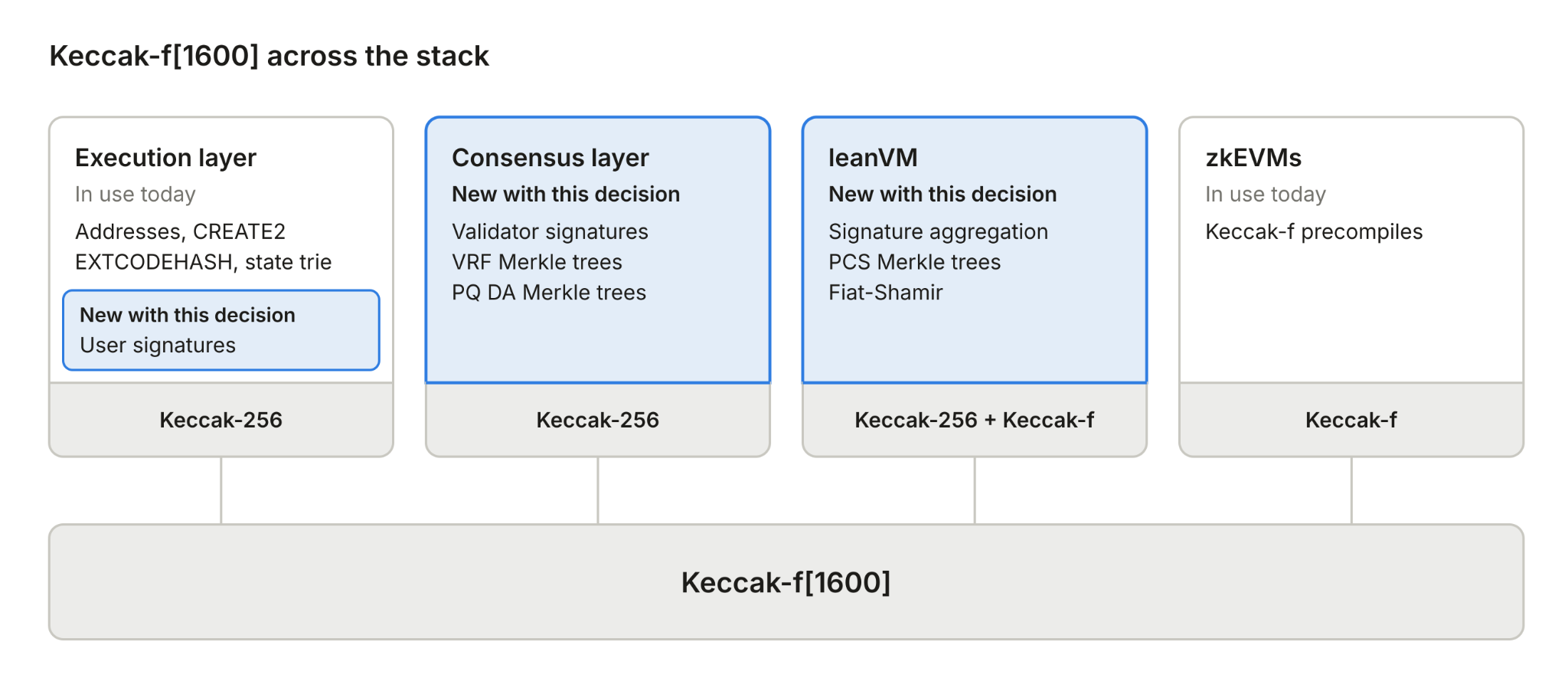
Keccak-256 has nearly two decades of cryptanalysis behind it and a large security margin. Ethereum already depends on it for addresses and execution-layer state, so doubling down on it means Ethereum avoids adding a third general-purpose hash into the protocol alongside SHA2-256.
Because we need more than a single hash function, we use a family of symmetric primitives derived from the Keccak-f[1600] permutation. This includes Keccak-256 for standard hashing, Keccak-duplex as the sponge object for Fiat-Shamir transformations, and SHAKE256 for pseudorandom bit generation and key derivations.
What changed: performance no longer picks the winner
Once Ethereum moves to hash-based cryptography, the security of the protocol reduces to the hash function: if it is broken, everything else is broken. The same hash also has to perform well in three quite different environments:
- On CPUs. Clients run it natively for signing and verifying, hashing the state trie and deriving addresses.
- In zkVMs. Signature, blob and recursive aggregation runs in leanVM, the zkVM we will use in the protocol. Proving cost per hash has to stay low enough not to bottleneck aggregation, which today means proving ~500K hashes per second, mapping to ~1K attestations per second which is enough to cover a committee on the consensus layer, on EIP-7870 equivalent hardware.
- In the EVM. Contracts compute the hash to verify signatures, check on-chain storage proofs, or power whatever niche application needs hashing. What matters is gas cost, which usually means a dedicated opcode or precompile.
For years, performance in the zkVM was the bottleneck; traditional hashes were too expensive to prove, so the working assumption was that Ethereum’s post-quantum signatures would need a ZK-friendly hash like Poseidon, trading well-studied security for proving speed. We spent years attempting to harden the cryptanalysis of Poseidon for this very reason.
That tradeoff is gone, now that SNARKs handle standard hashes efficiently. Binary-field SNARKs (Binius, Flock) and GKR-based provers now prove standard hashes at or well above the 500K hashes per second target. Proving performance no longer separates standard hashes from algebraic ones, so security becomes the deciding factor.
On security, the bar is high because the choice is hard to undo. The hash will protect Ethereum’s value for decades, so we want the largest public body of cryptanalysis and a security margin wide enough that breaking the hash would require completely new cryptanalysis. Where candidates are otherwise equal on this, we prefer to reuse what Ethereum already has to reduce ecosystem churn, since every new primitive has to be implemented, optimised, audited and fuzzed in every client, zkVM and SDK.
Narrowing the field
We compared five candidates: Poseidon/Poseidon2, BLAKE3, BLAKE2, SHA2-256 and Keccak-256.
The ZK-friendly hashes: Poseidon and Poseidon2
Poseidon (2019) and Poseidon2 (2023) were designed to be efficiently provable within SNARKs over prime fields, an advantage that binary-field SNARKs have largely removed.
In 2022, Bariant et al. showed the designers’ analysis was too optimistic, with a trick that skips two full rounds at almost no cost. Moreover, the EF’s Poseidon Cryptanalysis Initiative, launched in November 2024, keeps producing new attacks on round-reduced instances of both (Sanso and Vitto 2025, Bak et al. 2026). Neither full-round version is broken, but there is no reason to wait for the cryptanalysis to mature when traditional hashes are fast enough to prove.
We note that Poseidon and Poseidon2 are for all intents and purposes completely different hash functions. However, our conclusions for both are the same.
The fast hashes: BLAKE3 and BLAKE2
BLAKE3 (2020) is the fastest traditional hash we considered: provers already reach about 2.2 million BLAKE3 compressions per second on a 16-vCPU machine (SNARK.fast Flock Challenge).
But it both modifies the BLAKE2 round function and reduces the number of rounds from 10 to 7. As a result, the cryptanalytic attacks on BLAKE2 and BLAKE3 are not interchangeable, and the BLAKE3 cryptanalysis record is sparse. Moreover, the BLAKE3 mode of operation has no security proof, and the underlying blockcipher is known to have distinguishers for quite many rounds.
BLAKE2 (2012) is better studied, though it still has <10 cryptanalytic attacks published, and the best attacks on the hash reach 2.5 rounds (BLAKE2). It is still believed to be secure (and fast), and Ethereum exposes its compression function (for blake2f) through the EIP-152 precompile. We ultimately did not go with BLAKE2 due to the remaining hashes having significantly more cryptanalysis and sufficient performance.
The incumbents: SHA2-256 and Keccak-256
This leaves the two hashes Ethereum already uses.
SHA2-256 (2001) is used by SSZ on the consensus layer (CL), the 0x02 precompile on the execution layer (EL) and subsequently in the current deposit contract.
It is fast natively, especially with SHA-NI on x86. But practical collisions reach 35 of its 64 rounds, and the best collision attack reaches 38, more than half of its total rounds (Li et al. 2026, Zhang et al. 2026, Goldreich 2026).
The security proofs for hash-based signatures, and the Fiat–Shamir step in the SNARGs that aggregate them, treat the hash as a random oracle. SHA2-256, however, uses a Merkle–Damgård construction, so length extension alone is enough to differentiate it from a random oracle.
Consequently, schemes built on it need extra care: SLH-DSA-SHA2, for example, uses HMAC and MGF1 for some of its functions. The random oracle issue can of course be patched, but needing every protocol built on top of SHA2-256 to take extra care here is not desirable.
Keccak-256 (2008) has arguably the most extensive cryptanalysis out of all unbroken traditional hashes (Keccak team); moreover, its security has so far remained unaffected by the introduction of AI-assisted cryptanalysis.
Practical collision attacks reach 5 of its 24 rounds, and theoretical ones reach 6 rounds when evaluated on the underlying permutation used by Keccak-256, SHAKE128, and SHAKE256 (Guo et al. 2020, Zhang, Hou and Liu 2024). It is built on a sponge mode, which is provably indifferentiable from a random oracle if the underlying permutation is ideal, against classical adversaries, and with a loose bound, against quantum adversaries (Tokat, Alagic, Carolan and Majenz, QCrypt 2026). This means that the sponge is structurally security preserving, and that there are no attacks exploiting the structure of the sponge. But there could be attacks that attack the internal Keccak-f permutation directly.
Now, relative performance is where Keccak-256 compares badly to other traditional hashes, especially in the context of binary tree hashing. Nonetheless, LeanVM proves above 500K keccak-f/s on EIP-7870 hardware, which is sufficient for the required aggregation throughput, but it is slower to prove than BLAKE3 and natively slower than SHA2-256. We accept that relative performance cost for the security margin and historical cryptanalysis.
Keccak-256 vs SHA3-256
Keccak-256 and SHA3-256 share the same Keccak-f permutation, rate and capacity, so they have the same security, native speed and proving cost. The only difference is the padding bits. Essentially every cryptanalytic result on one applies to the other, and every Keccak-f accelerator works on either function.
The choice between the two came down to integration in Ethereum:
- It is already in the protocol. KECCAK256 is already an opcode and is used extensively on the execution and application layer.
- It avoids two near-identical functions. SHA3-256 next to Keccak-256 would mean two functions that differ by a single padding byte. Both are also confusingly informally called “SHA3” since technically Keccak is a variant of the SHA3 family. Not introducing SHA3-256 alongside Keccak-256 avoids a whole class of integration bugs.
- FIPS approval doesn’t help here. SHA3-256 is FIPS-approved and Keccak-256 is not, but choosing SHA3-256 would not make the signatures FIPS-compliant, because the signature scheme itself is not FIPS-approved. For users who need FIPS compliance, we will enable this with another protocol-level construction that allows the user to verify arbitrary computation cheaply.
What this means for clients
For most teams this choice needs little new code.
- EL clients: No new hash. Signature verification reuses existing Keccak-256 implementations. Moreover, when SSZ is introduced on the EL (this is a likely scenario with frame transactions), we recommend using Keccak-256 with it.
- CL clients: Keccak-256 is already used (discv5 node IDs use it). In the long term, we recommend moving SSZ merkleisation from SHA2-256 to Keccak-256.
References
- Keccak team: cryptanalysis track record
- Guo, Liao, Liu, Liu, Qiao, Song, Practical Collision Attacks against Round-Reduced SHA-3 (Journal of Cryptology, 2020)
- Zhang, Hou, Liu, Probabilistic Linearization: Internal Differential Collisions in up to 6 Rounds of SHA-3 (CRYPTO 2024, ePrint 2024/1136)
- Li, Liu, Wang, Shi, Pushing the Limit of Memory-efficient Collision Attack Framework for SHA-2 (ePrint 2026/1080)
- Zhang, Li, Gao, Wang, Collision Attacks on SHA-256 up to 37 Steps with Improved Trail Search (EUROCRYPT 2026, ePrint 2026/232)
- Tokat, Alagic, Carolan, Majenz: The Sponge is Quantum Indifferentiable (QCrypt 2026)
- BLAKE2 site: cryptanalysis FAQ
- SNARK.fast: Flock Challenge leaderboard (BLAKE3 proving throughput)
- EF Poseidon Cryptanalysis Initiative announcement (IACR, Dec 2024)
- Sanso and Vitto, Attacking Poseidon via Graeffe-Based Root-Finding (ePrint 2025/937)
- Bak et al., Claiming bounties on small-scale Poseidon and Poseidon2 instances (ePrint 2026/150)
- Bariant, Bouvier, Leurent, Perrin, Algebraic Attacks against Some Arithmetization-Oriented Primitives (ToSC 2022)
- Goldreich, 38-Step Collision Attack on SHA-256 (ePrint 2026/2913)
